How an alarm system works
All alarm systems have three basic parts:
1) Control equipment, the
"brains" of the system which contains the microprocessor,
the programming, power supply, and the means to
arm/disarm the system
2) Detectors, the
"senses" which see, hear, smell, or feel changes electronically
and are connected to the control equipment.
3) Annunciators, the
"mouth" which provides notification of a problem.
CONTROL EQUIPMENT
General Description
This is the single most expensive and important part of the alarm
system.The control panel contains the computer which determines the capabilities of the
system, and the system backup battery. All components of the alarm system are connected to
the control panel either by wires or wireless devices. The control panel is usually a
locked metal box installed near electrical and telephone sources. The newest generation of
control panels permit remote programming of the system. Control equipment which is listed
with Underwriter's Laboratory (U.L.) meets the highest standards.
Alarm Microprocessor
Also called the computer or "brain" usually determines
these characteristics:
Type/model of keypad
History buffer
Number of zones
Automatic arming
Number of user codes
Remote programmability
Number of partitions
Battery test
Detector tests
Customized arming/disarming
Power supply: primary/standby
All alarms have two sources of power: a primary source which is a plug-in 110
volt transformer and a standby source which is a 12 volt rechargeable battery. The battery
provides a regulated 12 volt power supply so that the microprocessor and detectors operate
properly and it also serves as a standby power source. Much like a car battery, the alarm
battery has a limited life span of about 3-5 years. The alarm microprocessor runs a
battery check every 24 hours. When the battery needs to be replaced, a low battery
condition is indicated on the keypad and a signal is transmitted to the monitoring
facility for those customers with monitored systems.
Keypads
Pushbutton keypads with programmable passcodes are now universally used to
arm/disarm alarm systems. Keypads are normally located at the main entry/exit points and
master bedroom. Indicator lights or word display show the status of the system, problems,
and open zones. Customized arming permits activation of selected zones or areas, e.g.
arming doors/windows while excluding the motion detector. A special "bypass"
permits arming the system with malfunctioning or non-operational detectors.
Commercial users usually give different codes to various employees. These systems record
who arms/disarms the system, the time of the event, automatically arm themselves, and may
limit access to certain employees.
DETECTORS
General Description
Detectors are the largest and most variable cost in an alarm system. The choice of detectors determines what conditions activate the alarm system. Detectors are categorized by Intrusion (Perimeter/Interior), Fire, Gas, and Environmental. Detector selection needs to balance risks, system stability, and budget.
Intrusion Detectors: Perimeter
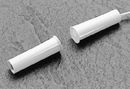
Doors and windows are protected using magnetic switches/contacts to sense their opening. Modern glass-break sensors, placed in a room, can sense breaking glass in that room.
Intrusion Detectors: Interior
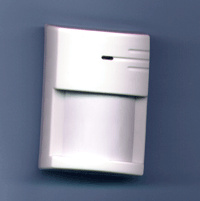
Motion detectors are used to detect movement in high traffic and high risk areas. They use
various methods of detecting movement. The most common motion detector is the Passive
Infra-Red (PIR) which senses body heat. New PIRs are able to operate even with pets. Other
motion detectors utilize micro-wave or ultra-sonic to detect movement. Photobeams are used
in large commercial applications. Floor mats are now obsolete.
Fire
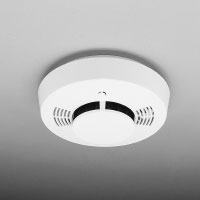
Fire detectors sense smoke and/or heat. Smoke detectors use two different sensing methods:
phototelectric and ionization. Photolelectric smoke detectors are preferred by most Fire
Marshals and are the type normally installed by alarm companies. Ionization smoke
detectors are what is normally installed by electricians in a home. Heat detectors
are activated when the room temperature reaches a set temperature, usually 135 degrees, or
when there is a rapid increase in room temperature. Heat detectors are usually placed in
garages or other areas where life safety is not the primary risk. Many models of
photoelectric smoke detectors also have a built-in heat detector. Many cities now require
a smoke detector in every bedroom, as well as, common hallways.
Gas Detectors
The two main types of gas detectors are: natural gas and carbon monoxide. Gas detectors sense one or the other not both types of gas. Carbon monoxide detectors are most common, since this deadly gas is tasteless and odorless.
Environmental Detectors
Low temperature, water, sump pump and furnace failure are only some of the environmental detectors available. Some appliances have built-in sensors which can be connected to an alarm system.
ANNUNCIATORS
General Description
Sirens sounding, lights flashing, the police/fire department
being notified are what most people associate with an alarm system. Annunciation of an
alarm usually occurs locally and/or remotely.
Local Annunciation
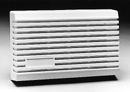
Local annunciation devices, sirens, bells, and flashing lights, alert
individuals at the premise that the alarm has been activated. To comply with noise
ordinances, most alarm systems have an automatic time out, and only use interior sounding
devices.
Remote Notification
The assurance that professional help is rapidly summoned to an alarm
situation is the purpose of remote notification.
One-way alarm notification is
usually done when the alarm system sends an electronic signal over the telephone lines to
a manned facility. Cellular telephone and radio transmitters are also used to send alarm
signals. A monitoring facility/central station is used by most alarm companies to provide
this service and ones listed by U.L. (Underwriters Laboratory) must meet special insurance
industry standards. Most alarm systems today are monitored at facilities which are
hundreds of miles away, some of which provide specialized services.
Two-way voice alarm notification
permits the alarm company to "listen-in" and "speak" over the alarm
system. This is done microphone/speakers and especialty trained operators. Two-way voice
is an important advancement where personal safety and alarm verification are a concern.
Cellular backup is used to insure
that the alarm transmission is received by the alarm company even if the telephone line is
cut or out of service.
Alarm menu
Alarm design Common
alarm problems Monitored systems
Service/additions/upgrades Pricing